Are You Setting KRAs That Drive Results Or Playing It Safe?
Rethink your approach to KRAs before they turn into dead weight.

The annual KRA setting process for all managers is a painful task because they have to set up the KRA for their team members and then for themselves.
Most of the time managers end up setting KRA or goals to tick the box rather than using it as an advantage to bring changes in the team and for themselves.
This not new because most of the companies, it is used as a compliance rather than really helping people to grow.
Irrespective of how the company operates, you can take charge of setting the KRA which are challenging and helps you to grow in the organisation.
In this blog, I will provide a thought process that could help you to set better KRAs for yourself and for your team members.
Mistake while setting KRA
One of the common mistake that managers do is to set KRAs every year which is not tagged to any business goals. Without alignment, the impact to company’s growth will not be present.
The other common mistake managers do is set similar goals to all roles. For example, in a software development team, front-end developers and backend developers roles should have specific goals that will help to build new skill as well as improve the way software is developed.
Furthermore, not defining key performance indicators (KPI) for KRAs is another common mistake. KPIs are the best ways to track the percentage of KRA success.
Due to the above many mangers set short term goals that are for 6months or 1 year without any relation to the business objectives. Some managers make short term goals vague like improve performance, or utilisation should be high etc.
Without knowing how the goals align to the business and not having clear path to reach it, the manager will start playing it safe to show that there is some improvements.
Hence there is a need to look at KRAs not just short term rather a few years and trace your steps backwards to identify annual goals that will help creating a larger impact to the organisation.
Transition to Long Term KRAs
I believe KRAs need not change every year.
The KPIs to achieve KRAs should be revised to meet the KRAs. For example, you want to reduce cloud infrastructure cost by 25%. It is difficult to reduce it in one year. So first year KPI could be to reduce by say 10% and following year another 10% and so on. Until the KRA of reducing the cloud infrastructure cost by 25% is met.
Considering the business is growing, every year there is an increase in cost due to new initiatives. As the business grows, the KPI can be adjusted for the year to achieve the higher objective.
This approach makes the KRAs always being in line with your organisation goals and KPIs keeps getting adjusted.
Another advantage, KRA need not be set every year. Because the KRAs are set for 3 years or 5 years and KPIs is helping you to track the progress towards achieving the goal.
By transitioning to long-term goals and using KPIs to keep a track on progress towards achieving it, there is continuous value addition to your organisation.
And your KRA which are relevant to organisation or business goals can be split into team goals and assign each team member specific goals based on their role in the team.
If I consider the cloud infrastructure cost reduction example, Cloud operations members can have KPIs to monitor the low utilisation resources and make sure any resource that is created should be 70% utilised otherwise it will be stopped or paused. This will help to control the cost.
Similarly, DevOps members can have KPIs to build better monitoring systems to keep the cost under control by defining a threshold of let’s say 75%.
Thus, by using long term KRAs that are aligned with business goals and using KPIs for every year to measure the progress will help to align yourself and your team to business objectives.
When the business objectives changes, KRA should change first and then the KPIs should identified for tracking the progress.
Mind Map of KRAs
The below mind map shows the process of arriving at the KRAs.
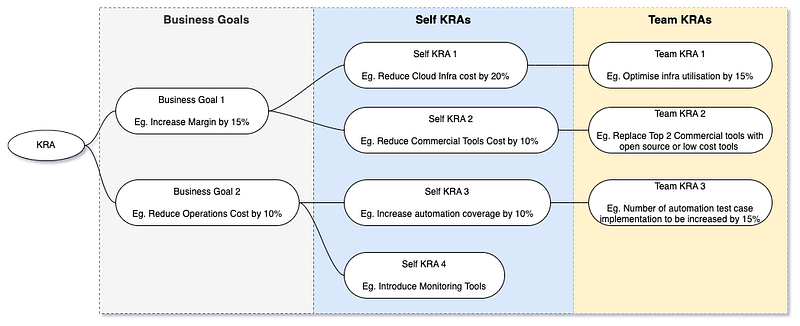
The process starts with the identifying the business goals. These goals can be discussed with your senior managers or leadership who are aware of such goals.
Once you are aware of business goals, start breaking it down to your KRAs that makes sense. Example, if the business goal is to increase the project margins going forward, then your KRA could be reduce one of the cost that incurs in the project, say cloud infrastructure cost.
Similarly, identifying various business goals and arriving at your self KRAs, will help you to align it to real business goals that adds value.
The next step, is to breaking it down further for your reporting team members.
The approach helps to not only align with the business goals, but also helps to continuing the same goals for at least 2 to 3 years and incrementally adding value to the organisation.
The approach also provides indication of whether the goal makes sense or it has no value addition.
Furthermore, the approach will help you to assess the real target of a particular KRA. For example, cloud infrastructure cost reduction can happen say up to 15% and no more. In this case, the KRA can be changed for the next year to maintain the infrastructure cost to that level. So that cost is always under control.
Conclusion
Aligning your KRAs to business goals makes the whole goal setting process more challenging rather than just picking some random or common KRAs.
The KRAs can be set for next 3 years with several milestones in the form of KPIs. In this way you can track the progress of achievement every year.
This approach also avoids do the KRA setting every year for namesake rather having real conversation on achievements and how to reach the overall target.
So, start transitioning from common, generic KRAs to business aligned, value-recognising KRAs that paves the way for your growth and your team members.
Happy management!