Micromanaging: What New Managers Need To Know

Recognise the signs of micromanagement and learn how to lead with clarity and trust.
New managers tend to check their team members' work more often than needed. Due to the fact that they want to ensure that the work is going in the right direction but most importantly to ensure their credibility stays intact.
Well "their credibility need to stay intact" why?
New managers are promoted because of the credibility they have built over the years of hard work as an individual contributor. The moment they are promoted to manager role, they always feel that they need to maintain it.
But the real issue is not that...
The real issue is that these new managers don't know yet,
- how to give detailed instructions or
- hesitate to hand over decisions
Why?
New managers fear missed deadlines, a poor outcome or being held responsible when they are not actually doing the work.
New managers want,
- good work like how they were doing as individual contributors,
- fewer surprises as they don't know yet how to handle it
- successful delivery to maintain credibility.
New managers feel they can achieve the above only by monitoring every detail of every team member. They don't realise that it is not managing, it is actually micro-managing.
Is micromanaging good or bad then? It become bad when it is the default way of leading. In high-risk situations, a manager may need oversight, but that oversight should be temporary, proportionate and focused on protecting the outcome.
The core idea behind management is,
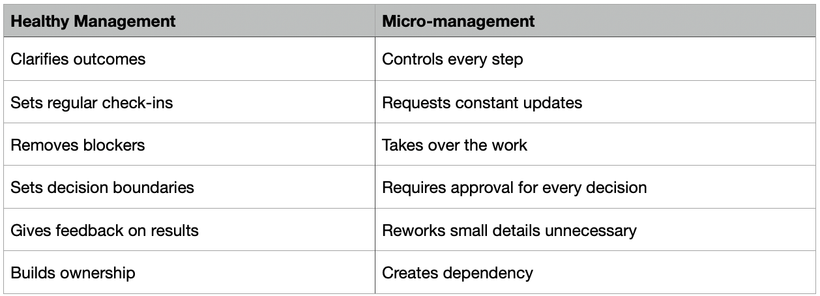
- Clarifying the expected outcome
- Removing blockers
- Hold team members accountable
- Agree on check-ins and the check-in agenda
- Give feedback to members
- Help members to make decisions
Managers do not do the work, managers ensure team members do the work by creating the environment in which they can perform and produce the required outcome.
When the progress is not as per the expectation, general tendency is to monitor every detail to ensure the team members are going in the right direction with request constant updates.
This leads to micromanaging every aspect of the team.
With Micromanagement, managers will,
- dictate every step of how work must be done
- request constant updates
- take over the work from the members
- reworks small details unnecessarily
- expects members to seek approval for every decision
- control every step team members take
With the above, the team members may feel lot pressurised as there is constant follow-up, corrections, deviations, smallest possible detail is checked and questioned.
Micromanagement creates pressured environment for team members which leads to poor performance, hesitant to take initiatives, making decision or even raise problems early.
Even though micromanaging the team gets you the results, micromanagement is not the preferred approach to get things done.
There are better ways management approaches that will provide results without manager checking every minor details.
So, to avoid micromanaging, there is a need for mindset change:
- Move from checking activity to checking outcomes
- Move from giving answers to asking questions that will help to understand the gap
- Move from controlling every decision to setting clear boundaries
- Move from reacting late to agreeing on early check-ins.
Remember that micromanagement replaces ownership with control.
Good managers provide direction and enable team members to become accountable.
Final thoughts
Micromanagement is often a signal that managers need more clarity about how things are progressing on the ground. It is not a sign that they are bad managers.
Micromanagement may be required or used during crucial stages of the project where missing the smallest detail could derail the whole project. But otherwise the general approach should be to provide direction and evaluate the outcome to understand how things are progressing during regular check-ins.
Additional Reading
Read about Why managers should avoid doing team's work and what to do instead?
Read about How individual contributors can transition to management role?
Free Udemy Course How New Managers Can Succeed In Management Role.