C.A.R.E.S Framework | Effective Way to Manage Low Performers
Introducing CARES Framework to effectively manage and improve motivation of low performers in the team.
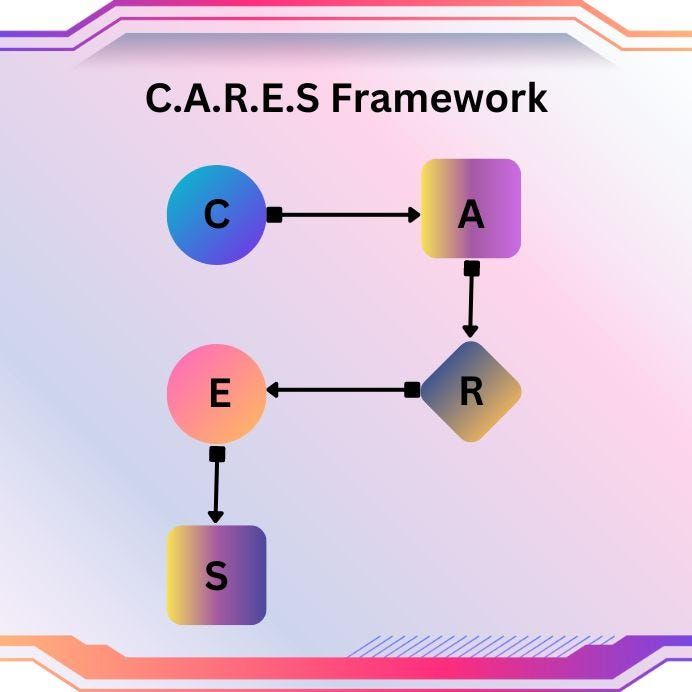
Many young managers do not know how to manage and mentor low performers in the team. They get frustrated as these low performers are not able to align and match with the rest of the team velocity.
Introducing C.A.R.E.S framework to help all young managers to effectively manage low performing team members and help them to become better.
The objective of CARES framework is to help managers to better manage low performers to increase their motivation and skill levels.
If you are not sure how to understand your team better, here is a link to a blog which talks about situational leadership style.

What is C.A.R.E.S?
It stands for, Communicate.Accountability.Roadmap.Execution.Support.
It is a 5 step framework to help managers for effective management of low performing team members. The framework defines key steps to make low performers to move towards becoming better and align with the rest of the team velocity.
Is this another performance improvement program that HR creates? The answer is no.
The CARES framework is a tool for the managers to help manage the low performers. These team members are still valuable to the team and you believe that their presence in the team will help.
Helping low performers to better perform is the main intent of the framework rather than taking an extreme step of letting go.
Also, this framework is not initiated by HR. It is between the manager and the team member. So, the team member does not take this as a threat in loosing the job.
Note that once HR initiate the PIP program, then team member do have a threat of losing the job.
The following sections talks about each step in detail.
C — Communicate
Many young managers make a mistake of not communicating the performance to the low performing team members. They wait for year end feedback process. Until then the managers try to cope with the performance issues.
The first step for young managers to come out of the vicious cycle of low performers continuing what they are doing, is to communicate that there is an issue.
While communicating about low performance to any team member, there must be clear outline in the form of email or documentation, which states the task and its expected results, actual results and how it links to a performance issue followed by a discussion.
The evidence of low performance cannot be just 1 instance. There should be multiple instances. Such performance issues should be observed at least for last 6 months.
In the meeting where the low performance is discussed, it should not be one sided. It is important to note the team member view as well.
Upon agreeing on the areas where performance issue exists, there must be a document or an email which is shared with the team member as a minutes of meeting.
The communication cycle can be multiple depending on the depth of the issues. But it is important to perform the step with at most care, as it will set the tone for the rest of the framework.
A — Accountability
Once the performance issues are understood, it is important to clarify and set the accountability that team member carries.
Few samples of accountability for a software engineer are as follows.
- Requirement clarification before code
- On time release of assigned tasks
- Regular updates about dependencies and issues
- Documentation about the design or assumptions
- Adhering to the process
and so on.
The accountability could vary from one team member to another based on the role that team member is playing in the team.
It is important to highlight all the expected accountability. Also clarifying doubts about it.
The setting up of accountability should not be one sided. Your team member should also agree. If there is disagreement, then the accountability should be redefined or removed from the list.
It is important to capture the points related to accountability and share it with the team member for reference.
It is important to note that the accountability are not goals.
These are the activities that the team members are expected to perform to achieve a goal or to complete a given activity.
R — Roadmap
In this step, both the manager and the team member should decide the roadmap to become better at the job.
The roadmap must be defined at most granular task level. If it is at high level, it will lead to interpretation problems.
The roadmap should span at least 3 months. Anything less than this will not be helpful as there is less time to evaluate the progress.
Some manager may choose to change the role of the team member within the organization for better fitment. This decision should be taken considering that the team member is okay to give it a try and higher management is also okay to transfer to a different role.
While setting up the roadmap, following are some points to keep in mind.
- Don’t assign a work or task which you known the team member will not perform. Find a task or activity which can be completed.
- Don’t assign same mentor or lead as before. It would be recommended to change the mentor or lead to help for a fresh start.
- The roadmap should include milestones which are initially easy to achieve to boost the confidence and then slowly increase the difficulty.
One of the easiest milestone could be preparing documentation for modules. - If organisation has a Learning and Development team, it would be good to check for relevant trainings on soft skill and agree on number of hours of training to be completed.
- Roadmap should include clear guidance on when the evaluation will occur and on what accountabilities or parameters will be used.
The roadmap should be created to make sure there is slow increments to responsibility for the team member.
The successful execution of this step will decide the end result.
E — Execution
Once the roadmap is agreed, the execution of the roadmap should begin.
The definition of done for each granular task must be agreed before the execution start.
The execution should be tracked to every step in the roadmap and its completion. During the roadmap execution, the evaluation should happen at each of the milestones agreed.
The evaluation should not be your word against team member’s word. It should be purely based on the parameters and accountability that has been discussed in the previous steps.
It is also suggested to invite lead or mentor assigned so that there is no gaps in the evaluation.
In each evaluation, there must a decision on whether to continue the existing milestone or aim for the next one based on definition of done.
It is important to note that the milestones are not just checklists to tick off. It should be used as a means to measure progress.
This step should be repeated until all the milestones are completed.
S — Support
At every step during the roadmap execution your support will be required.
The support can come in form of regular feedback or discussion on the progress, course correcting the milestone, providing small training sessions and so on.
As a Manager, it is not enough you to agree on a roadmap and define milestones. It is important to follow it through the journey of the roadmap with your team member.
Without a share of support from the manager in the roadmap execution, the framework will loose its purpose.
You can conduct 1-on-1s during this time in the context of the roadmap execution. But keep in mind that always allow your team member to express his thoughts and perspective as well.
If you would like to know what are the mistakes to be avoided during 1-on-1s then here is the link to blog.

That’s it. Use the framework for benefiting your team members who needs boost in their performance, in-turn helping you to achieve the overall team goals.
If you want to share your story on how this framework helped you or if you like me to expand on any of the specific step in the framework, please leave a comment.