5 Step framework for Delegation
In this blog, I will talk about effective delegation by using a 5-step framework for building high performing team.

Delegation is one of the powerful management style that every manager should be aware. If you do delegation right then you will end up building a high performing team.
Due to lack of training or knowledge on management styles, many managers are not aware how to delegate in the right way. Because of this they struggle to create opportunities for team members.
Without delegation,
1. as a manager, you will be stretching more than your team members,
2. your team members are always waiting for your inputs or decisions,
3. your team members don’t see any growth or learning opportunities,
4. your team members don’t take full responsibilities of the assigned work.
In this blog, I will talk about the 5-step framework for delegation, which is simple to use and in-turn helps you to build a high performing team.
5-Step framework
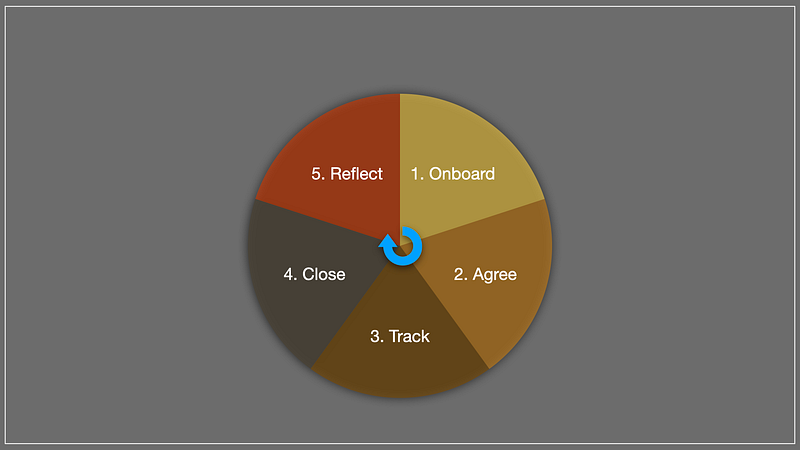
Delegation is all about transferring responsibility to another person.
As a manager, when you transfer the responsibility of completing a given task or an activity, the team member becomes equally accountable.
The 5-step framework helps you to execute the process of delegation in an effective way, so that there is a win-win situation for you as well as your team member.
Let’s look at each step in more detail.
▸ Step#1 : Onboard
The first step is to pick a team member for delegation for onboarding the team member to the project.
In onboarding step, align the team member to your thoughts by setting the right expectation.
So, while onboarding, make sure you cover the following items.
- Importance - by explaining about the importance of the project, team member will understand the seriousness of the project.
- Opportunities - by explaining about the learning opportunities the project creates; team member’s morale will boost.
- History - by explaining about the history of the project, team member will think of doing differently instead of trying out something that has not yielded results in the past.
It is important to note that the onboarding step is the foundational step. So spend as much as possible time here to clarify any doubts with the team member and set the right expectation.
▸ Step#2 : Agree
Once the team member understands your expectations, opportunities it creates and history, it is time to agree on details about executing the project in hand.
In agree step, discuss the execution aspects of the project for better outcome.
So, agree on the following items.
- Definition of Done - by discussing about the definition of done, team member understands your view of the scope for the project.
- Tentative Timeline - by discussing about the timelines or cost or effort, team members will know by when the project must be completed and with what constraints.
- Risks and concerns - by discussing about risks or concerns, team member can document and schedule further meetings needed.
It is important to agree on the details of the project that you are delegating to a team member. Discuss any any additional topics that would help the team member for better outcome.
▸ Step#3 : Track
After you and team member agree on the scope of the project, the team member can start working on the project.
In track step, decide the process of execution for steering the project in right direction.
So, decide on the following items.
- Execution methodology - by deciding the method of project management, tracking of progress will become seamless.
- Review meeting cadence - by deciding the cadence for review meetings, the progress, pending tasks, risks, and issues can be discussed regularly.
- Demo meeting cadence - by deciding cadence for demo meetings, the visual check of the progress can occur regularly to provide feedback.
It is important to make sure you are available when the need arise during track step. This will make sure, the team does not wait for the meetings to resolve any issues or concerns.
▸ Step#4 : Close
As the project is coming closer to definition of done, it is time to think of how it will be handed over to the downstream team.
In close step, activities like deployment plan or handover to QA or creating artefacts to downstream teams should be planned and executed.
So, discuss on the following items for closure.
- Rollout - how the project can be rollout to QA, integration environment and then to the users, should be discussed and planned.
- Documentation - the documentation updates that are required and when they can be completed, to keep the guides inline with the changes.
- Materials - discuss about demo recordings or screenshots or any marketing material to be prepared that will help sales and marketing teams.
Any delegated work should go through the E2E cycle and all the steps should be executed and handed over.
▸ Step#5 : Reflect
Once the project is completed, it is time to retrospect with the team member. This will help to do things better next time.
In reflect step, discuss on how things went, for identifying areas of improvement, which in-turn creates learning opportunities.
So, do the following to understand how things progressed.
- Receive feedback - receiving feedback from your team member, will help you to understand from team member’s view on how things went. This will further help you to understand what you can you do better next time.
- Provide feedback - providing feedback to your team member on how things progressed with samples, will help the team member to realise the mistakes and learn from it.
- Improvements - when there are feedback from both sides, identify improvement areas. For each improvement area, agree on the next steps and plan it.
The reflect step will create learning opportunities for you and the team member. This will keep you team member’s morale high.
Conclusion
It is important to remember that, once you delegate, follow it up and follow it through.
The 5-step framework will help you to delegate in the right way and in turn creates the win-win situation.
When the delegation is done right, it will result in the following.
- team members will feel they are taking complete ownership,
- team members will feel they are taking higher responsibilities,
- team members will feel they are taking part in decision making,
- you will be able to keep the team’s morale always high,
- you will get more time to take care of strategic things.
With the above you will be in the path of creating a high performing team.
Happy management!